03 / THE DEVELOPMENT STORY
One project.
A lot of learning.
Building across disciplines meant learning new tools, working through constraints, and returning to the details.
01From loose wires to a custom PCB
Early experiments used hand-soldered components. Unstable readings and an unusable first circuit board made the importance of research and planning clear. Learning electrical schematics, component footprints, and KiCad led to a series of increasingly reliable PCB revisions.
02An enclosure shaped by iteration
The enclosure was designed in Autodesk Inventor and developed through repeated 3D prints. Designing functional parts introduced constraints very different from visual modelling. The housing evolved from a larger, modular design into a smaller, more refined form.
03Firmware that meets the hardware
The ESP32 firmware is written in C++ using PlatformIO. An early five-display design exposed memory and UI-library limitations. Shared framebuffers and revised display handling helped resolve those challenges. A version without displays became the focus for testing the core system before adding more complex visual features.
04A desktop app built around the system
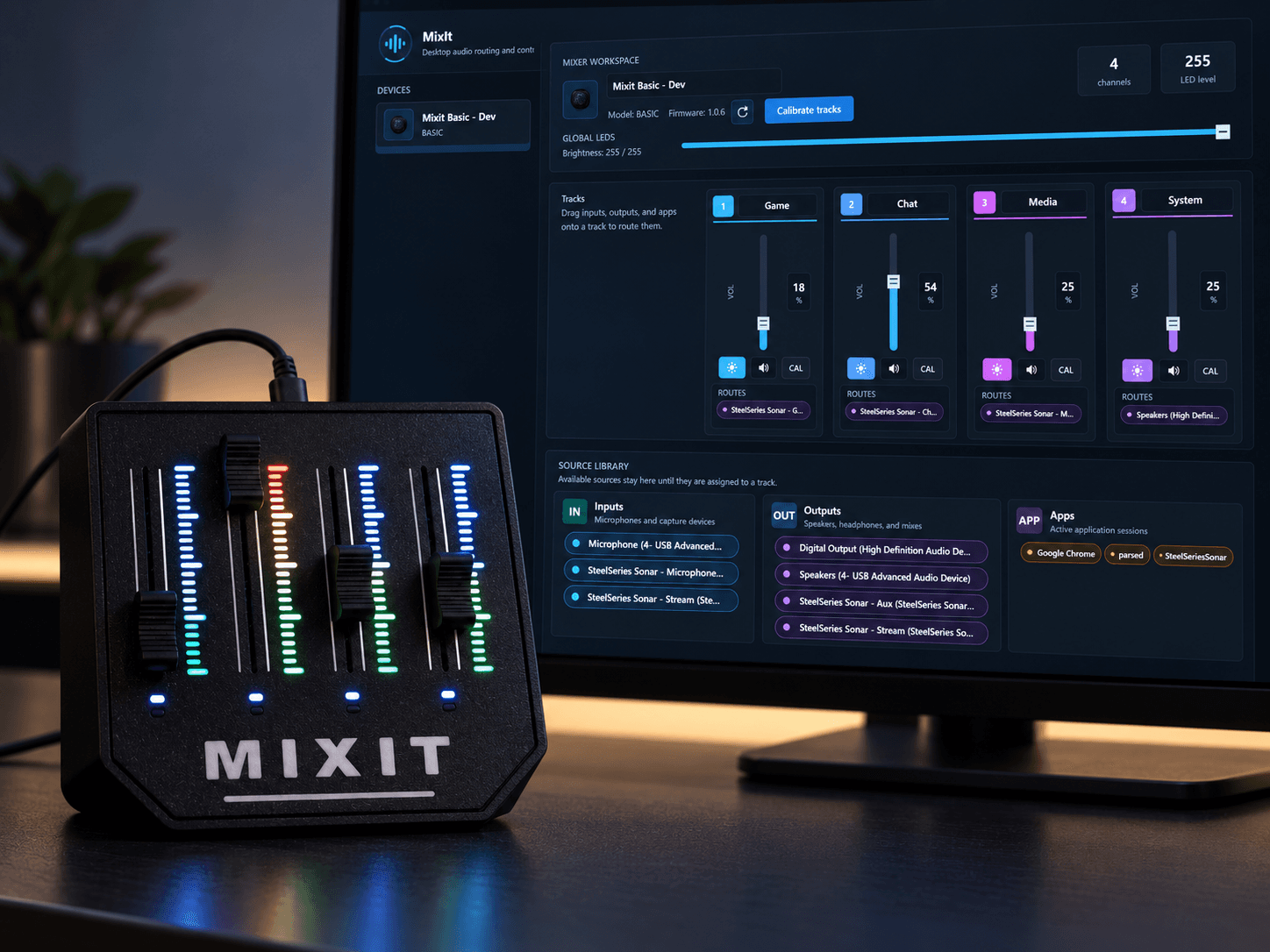
The desktop application uses C#, .NET, and Avalonia UI. USB device detection, application audio control, and deeper operating-system integration shaped that choice. The interface lets users choose which applications they control and how those controls are presented.
05Making updates easier
Sending a prototype to a friend revealed how cumbersome manual firmware and desktop updates were. A companion Next.js web app and backend API are being developed for version checks, release management, and update distribution. This remains an area of ongoing development.
06The result, and what comes next
The portfolio documents a working device used daily, with development continuing around distribution and updates. MixIt brings hardware, firmware, and software together, and reflects a way of working built on learning, testing, and improving one revision at a time.